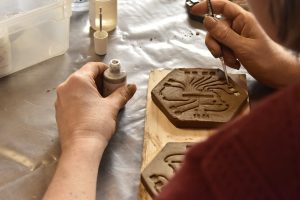
 It is an open secret that the hardware in our smart devices contains not only plastics but also conflict minerals such as tungsten, tin, tantalum, silver and gold. Participants of the workshop Feminist Hardware, led by Stefanie Wuschitz and Patrícia Reis, participated in the artists’ ongoing research on ethical hardware to develop and speculate upon renewable practices for the benefit humans and non-humans. During the two-day workshop, they created printed circuit boards (PCBs) with locally-sourced, natural clay and low-impact, recycled and urban mined materials, challenging the common PCB economies in an artistic, creative, and responsible way. Applying feminist hacking as an artistic methodology and critical framework, Stefanie Wuschitz and Patrícia Reis guided participant through a process that engages with the body, invites slowing down, and embraces failure as part of learning. This patient work is a act of care and attunement towards the materials involved in the production of digital technologies and the beings that so generously donate them for our use.

Stefanie Wuschitz is an artist, activist and educator whose work explores feminist, queer and decolonial approaches to technology. She holds an MFA in Transmedia Arts from University of Applied Arts Vienna; a MPS from TISCH School of the Arts; and a PhD on “Feminist Hackerspaces” at the Vienna University of Technology. She is the founder of the feminist hackerspace Mz* Baltazar’s Laboratory.
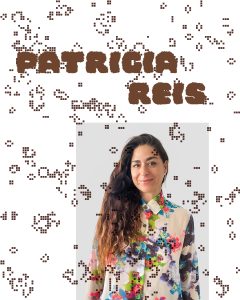 Patrícia J. Reis is a media artist, researcher and lecturer at the University of Applied Arts in Vienna. Her work explores the entanglements of living and technological systems through feminist hacking, sensory interaction, and embodied interfaces. She holds an MA in Media Art at the Lusófona University in Lisbon, and a Ph.D. in Art at the University of Évora, Portugal.